
 Donate to Museum Windsor
Rose City Roots · City and Society · Local story
Jackson Park
THE 1880s TO 2026The park at Ouellette Avenue and Tecumseh Road has been a racetrack, a First World War billet, a Depression garden, the stage of the Greatest Freedom Show on Earth, a royal reception ground and a memorial to Windsor's airmen. This page follows that ground through the records, says where the records disagree, and marks what we could not confirm.
The racetrack
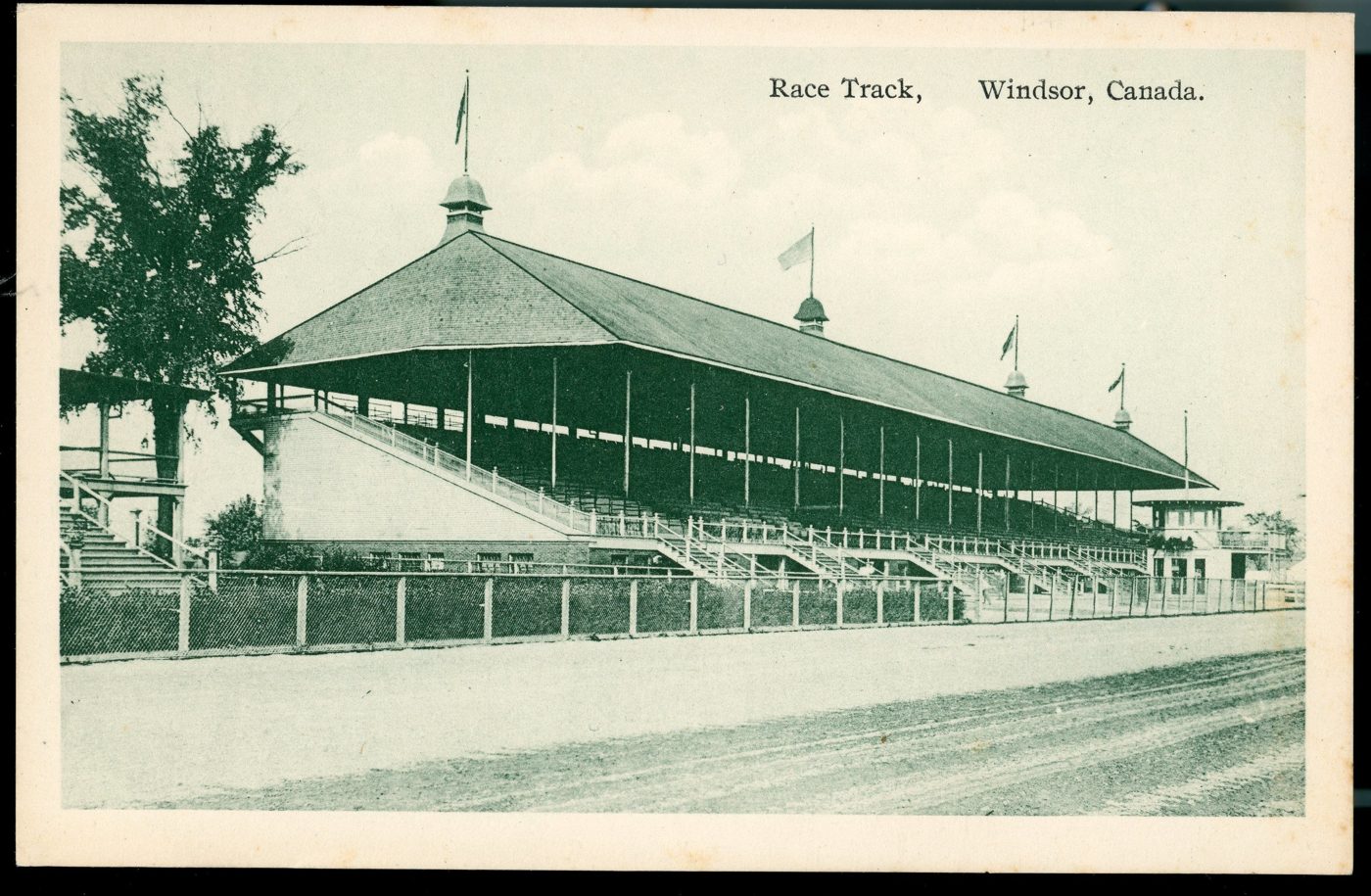
- 1880s to 1913 The Windsor Driving Park. Racing on the corner of Ouellette and Tecumseh was run by the Windsor Fair Grounds and Driving Park Association. Museum Windsor's record says Detroiters came because betting was banned in Michigan. Sources: Museum Windsor catalogue P10087 (Jackson Park, old Windsor Driving Park) · SWODA: Race Track, Windsor, c. 1925
- 1913 to 1920s The Windsor Jockey Club. The track became the Windsor Jockey Club. SWODA dates its grandstand to about 1910 to 1912. Sources: SWODA: Race Track, Windsor, c. 1925 · Museum Windsor catalogue P10087 (Jackson Park, old Windsor Driving Park)
- 1914 to 1918 Soldiers on the grounds. Museum Windsor's record says troops of the 99th Battalion, CEF, were housed in buildings on the property during the First World War. Windsor War Chest tells the battalion's story. We found no record of Second World War barracks here. Source: Museum Windsor catalogue P10087 (Jackson Park, old Windsor Driving Park)

A park, and its name
- December 1927 The vote. Windsor voters approved a bylaw to buy nearly 70 acres from the Windsor Jockey Club for a park, sports field and school site. Kennedy Collegiate was later built on part of the land. Sources: Windsor Public Library: Jackson Park · Windsor Public Library: Cecil E. Jackson · Museum Windsor catalogue P10087 (Jackson Park, old Windsor Driving Park)
- 1929 Named for the mayor. The park was named for Mayor Cecil E. Jackson in 1929. Sources differ on the month. SWODA says it was officially named in July 1929; the City's parks history says council approved and named it in December 1929; Museum Windsor dates the purchase to 1928. Sources: Windsor Public Library: Cecil E. Jackson · SWODA: Jackson Park postcard, c. 1963 (notes) · City of Windsor, Rediscover Our Parks, ch. 1 · City parks history, as quoted by International Metropolis (2014)
Gardens, gates and monuments
- 1930 Depression work. Work on the sunken gardens began in 1930 as a federally supported relief project; the City's parks history gives the pay as $1.25 a day. Sources: City of Windsor, Rediscover Our Parks, ch. 1 · City parks history, as quoted by International Metropolis (2014)
- 1931 The gates. The wrought-iron gates at Ouellette and Tecumseh were designed by J. C. Pennington and John Boyde and made in Norman Eansor's blacksmith shop on McDougall Street. They were designated a heritage property in 1999. Sources: International Metropolis (2022) · City parks history, as quoted by International Metropolis (2014) Secondary sources only.
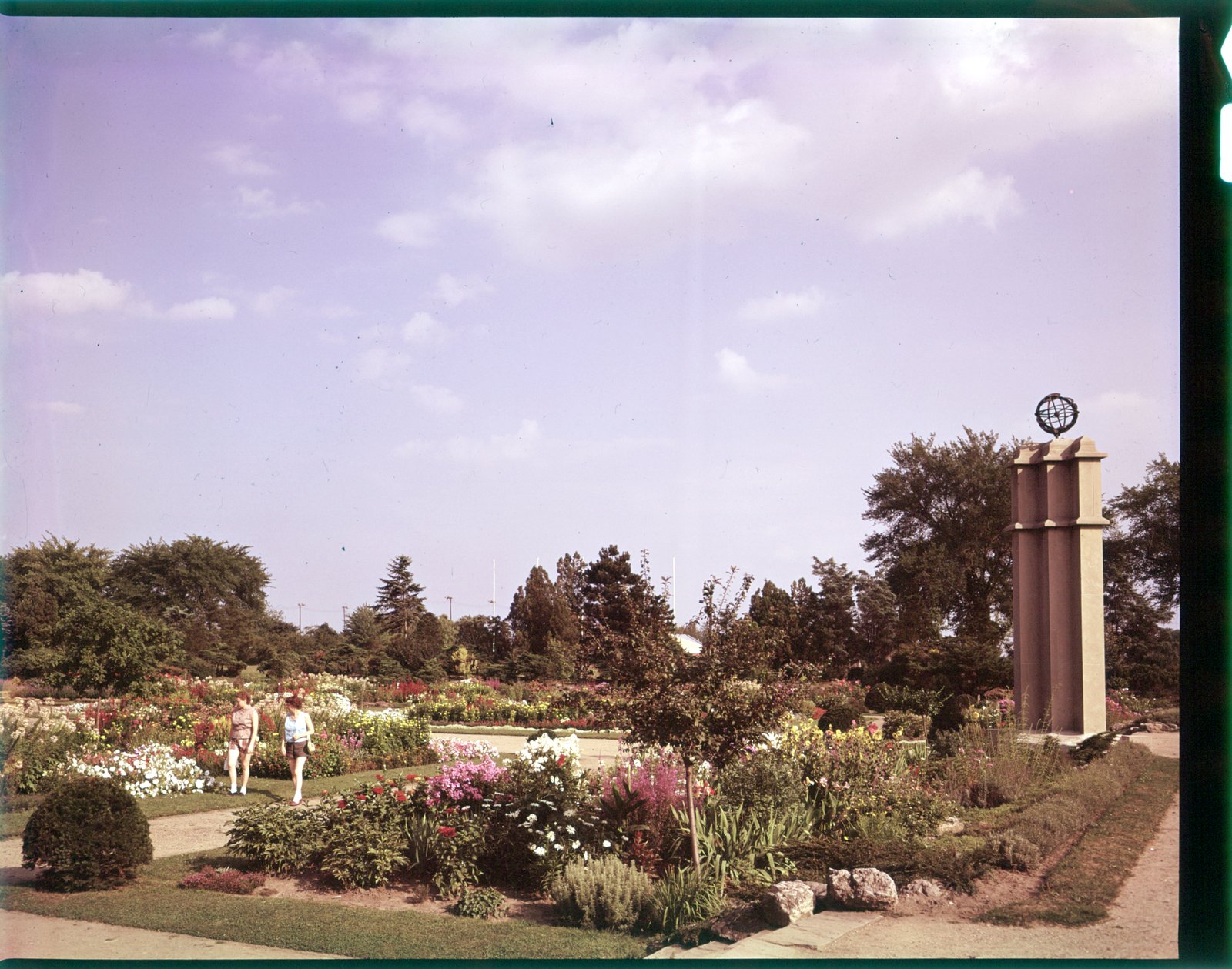
- 1930s to 1954 Monuments arrive. The South African War memorial was moved here from the downtown post office in the 1930s; a Robert Burns memorial followed in 1952 and a Copernicus sundial, given by the Polish Canadian Congress, in 1954. Source: City parks history, as quoted by International Metropolis (2014)
- 1967 A rose garden for the Centennial. The Memorial Rose Garden was planted for Canada's Centennial with the Greater Windsor Foundation, whose City of Roses campaign gave Windsor its nickname and this section its name. Sources: City parks history, as quoted by International Metropolis (2014) · Leddy Library: the City of Roses campaign

Fire Fighters' Field Day, 1935

The Greatest Freedom Show on Earth

- About 1932 Walter Perry begins. Walter Perry began organizing Windsor's Emancipation celebrations about 1932. We have not found where the 1932 to 1934 events were held. Sources: CBC News, 2 Aug 2019 · Windsor Public Library: Walter Perry
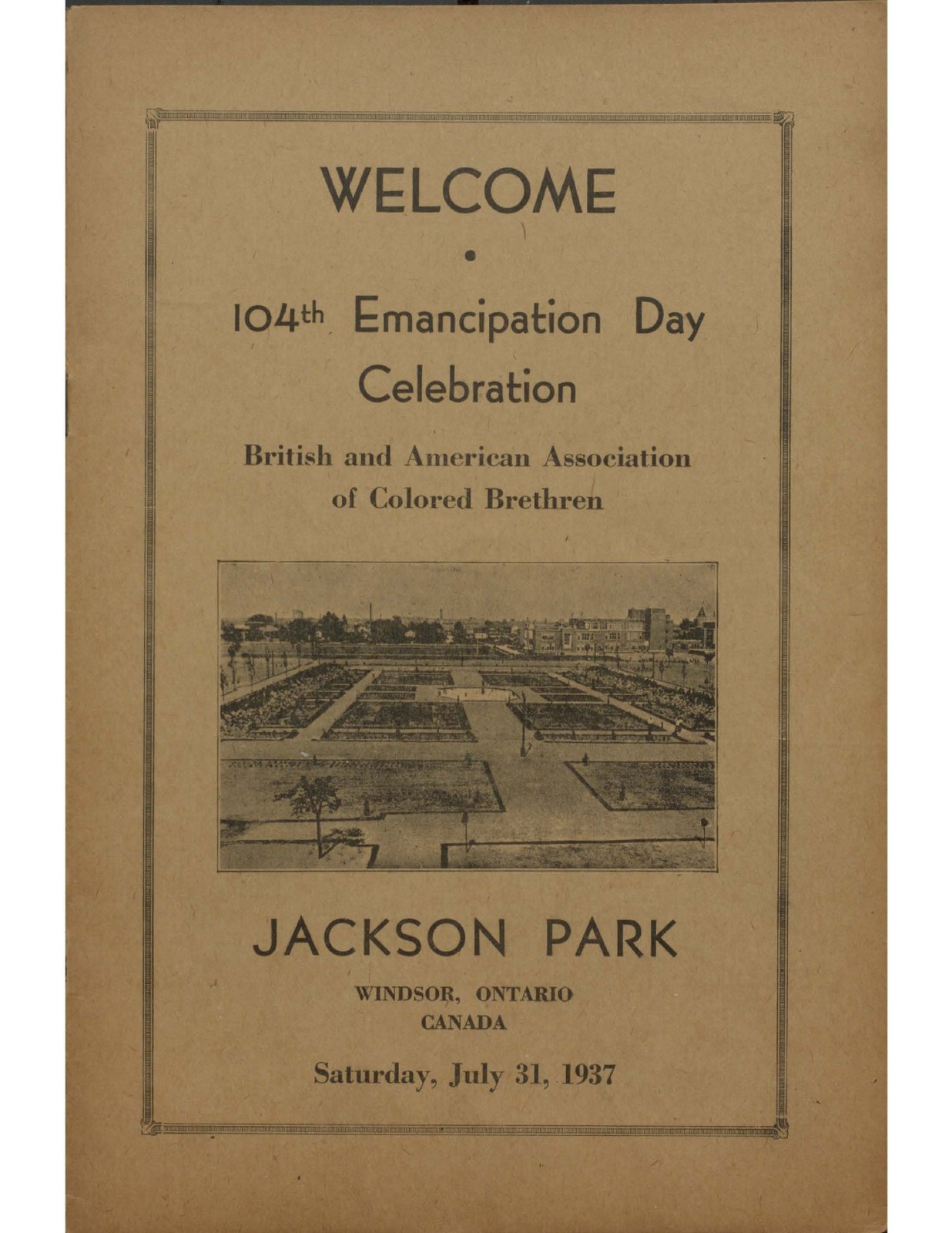
- 1935 to 1966 Jackson Park every summer. In 1935 the region's main Emancipation celebration moved to Windsor, and the University of Windsor's program collection runs every year from 1935 to 1966. Speakers named on the City's monument panels include Martin Luther King Jr. during the Montgomery Bus Boycott, Eleanor Roosevelt, Mary McLeod Bethune, Adam Clayton Powell and Benjamin Mays (1956). Myrlie Evers spoke six weeks after her husband's assassination. The University of Windsor counts over 35,000 people in 1959. Sources: City of Windsor: Emancipation Celebration Monument · UWindsor Scholaris: Emancipation Celebration Programs · University of Windsor: Walter Perry
- 1946 to 1948 On the grandstand stage. The City's panels place the 1946 Miss Sepia pageant on the grandstand stage, and date the first issue of the program magazine Progress to 1948. Source: City of Windsor: Emancipation Celebration Monument
- 1950 to 1959 The bandstand burns. A bandstand built in 1950 stood with the old Jockey Club grandstand. Both burned in July 1957, and a new bandshell followed in 1959. Sources: City of Windsor: Emancipation Celebration Monument · City parks history, as quoted by International Metropolis (2014)
- 1967 Cancelled. After the Detroit uprising, city council voided the celebration's contract and Perry called off the 1967 show less than a week before it was due. It would have been the 35th anniversary. Perry died on 17 August 1967. The 1968 celebration was cancelled too. Sources: JPP Exhibitions: 1967 celebration cancelled · JPP Exhibitions · 1967 program record
- 1 August 2026 The monument. The Emancipation Celebration Monument opened in Jackson Park, its arch shaped like the proscenium of the bandstand that burned in 1957, with murals by Dennis K. Smith and panels by Irene Moore Davis. A bronze of Walter Perry by Mark Williams is planned. Sources: City of Windsor: Emancipation Celebration Monument · City of Windsor news release
We never write a single 1932 to 1967 range for Jackson Park. Perry organized from about 1932; the Jackson Park programs run 1935 to 1966; 1967 was cancelled.
Royal visits
- 6 June 1939 The King and Queen in Windsor. King George VI and Queen Elizabeth visited Windsor on 6 June 1939. We found no record that ties that visit to Jackson Park or to the gardens' name. Sources: SWODA · Canadian Encyclopedia
- 15 October 1951 A princess in the park. A Detroit Historical Society photograph carries a typed note on its back: "Detroit Police Department Escort at Entrance to Jackson Park, Windsor, Ont., On the Occasion of the Public Reception of Their Royal Highnesses, Princess Elizabeth and Duke of Edinburgh." Ford of Canada's Ford Graphic confirms the royal day in Windsor. One record for the park itself. Sources: Detroit Historical Society 2016.117.051 (photo verso, 15 Oct 1951) · Ford Graphic, October 1951
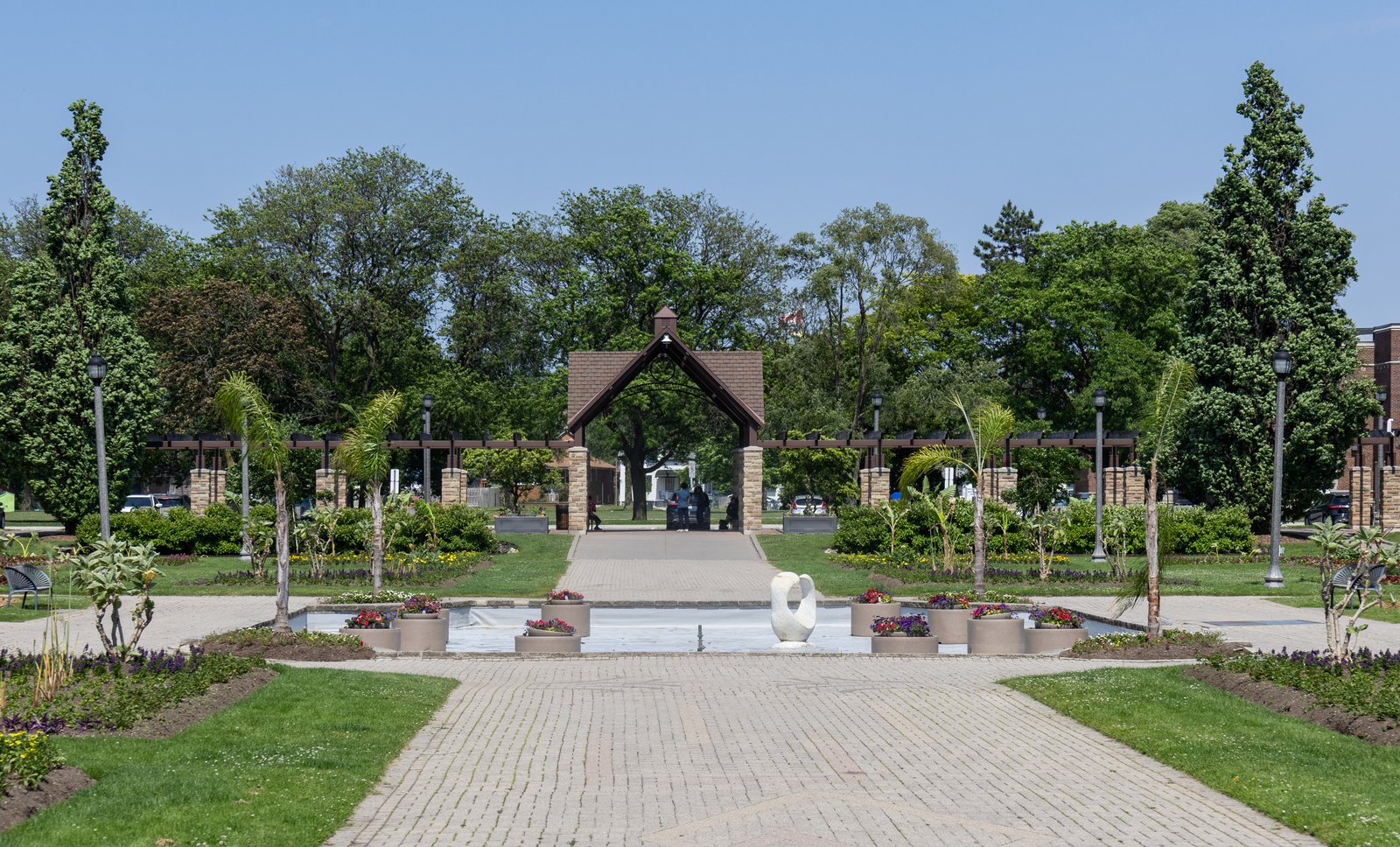
- After 1984 Queen Elizabeth II Gardens. After the Queen's 1984 visit, the gardens were renamed for Queen Elizabeth II. The City's parks history names the rose gardens; a City report quoted by the Windsor Star names the sunken gardens. Sources: City parks history, as quoted by International Metropolis (2014) · Windsor Star, on a City report about the Sunken Gardens · City of Windsor: Jackson Park
The Lancaster
- 1964 A bomber for $1,250. A "Lancaster for Windsor" committee led by Wing Commander Joseph Mencel, with members of the Air Force Club of Windsor, persuaded the City to buy Lancaster FM212 for $1,250. It came by barge from Dunnville to Dieppe Gardens in August 1964. Sources: Canadian Aviation Museum: Lancaster FM212 · City of Windsor: RCAF Memorial, Jackson Park
- Early 1965 To the park. The aircraft was moved to Jackson Park in the winter of 1964 to 1965 and set on its pedestal. Sources differ: January or February 1965. Sources: Canadian Aviation Museum: Lancaster FM212 · Vintage Aviation News: restoring FM212
- 4 July 1965 Dedicated. The Canadian Aviation Museum says FM212 was dedicated to the approximately 400 airmen from this area who died in the Second World War. Its plaque, erected by the Lancaster Memorial Committee in 1965, is now in Dieppe Gardens, with a granite copy in the park. Sources: Canadian Aviation Museum: Lancaster FM212 · City of Windsor: RCAF Memorial, Jackson Park · Veterans Affairs Canada
- 26 May 2005 Off the pedestal. FM212 was taken down for restoration by the Canadian Historical Aircraft Association, now the Canadian Aviation Museum. Hurricane and Spitfire replicas now fly over a garden outline of the Lancaster. Sources: Canadian Aviation Museum: Lancaster FM212 · City of Windsor: RCAF Memorial, Jackson Park · Windsor News, 7 Nov 2026


Connections between records
Links we found between separate records. Each says how strong it is.
The Jockey Club grandstand that SWODA dates to about 1910 to 1912 is the "former Jockey Club grandstand" the City's records pair with the 1950 bandstand, the stage of the 1946 Miss Sepia pageant, and the building that burned in July 1957. The 1913 race-meet photograph very likely shows the same grounds.
How strong: documented in separate records; the 1913 photo match is our reading. SWODA: Race Track, Windsor, c. 1925 · City of Windsor: Emancipation Celebration Monument
Princess Elizabeth was received at Jackson Park on 15 October 1951. After her 1984 visit as Queen, the park's gardens took her name.
How strong: two separate records; the 1951 park reception rests on one photograph note. Detroit Historical Society 2016.117.051 (photo verso, 15 Oct 1951) · City parks history, as quoted by International Metropolis (2014)
The same ground that housed 99th Battalion troops in the First World War became, in 1965, Windsor's memorial to its Second World War airmen.
How strong: both documented; the pairing is ours. Museum Windsor catalogue P10087 (Jackson Park, old Windsor Driving Park) · Canadian Aviation Museum: Lancaster FM212
The 1967 show was billed as the 35th anniversary. Counting back fits a first celebration under Perry in 1932 or 1933, which matches the CBC account of a 1932 start.
How strong: an inference from two sources. JPP Exhibitions: 1967 celebration cancelled · CBC News, 2 Aug 2019
What we corrected
- The gardens are not named for the 1939 royal visit. The records tie the name to Queen Elizabeth II after her 1984 visit.
- The naming year is 1929 in every source we found; the month is not settled, so we give the year only.
- The Lancaster's move to the park is dated January 1965 by one source and February 1965 by another. We say early 1965.
- Jackson Park's Emancipation programs run from 1935 to 1966. Perry's organizing began about 1932, and 1967 was cancelled.
Still open
- Where the 1932 to 1934 celebrations were held.
- A primary record of the 1929 council vote that named the park.
- Newspaper coverage of the 15 October 1951 reception in the park.
- Photographs of the 1950s bandstand that are cleared for use.
Know more? windsornewsdesk@gmail.com