
 Donate to Museum Windsor
Rose City Roots · Timeline
The Timeline
TIME IMMEMORIAL TO 2026Eleven chapters and one local story. Every entry links to its sources. Where sources disagree, or we have only one, the entry says so.

Everything in order
- Time immemorial Homelands on both shores. The Anishinaabe Three Fires and the Wyandot live, fish, farm and trade along the strait. In the 1700s Odawa and Huron-Wendat villages stand on the south shore, the side that is now Windsor (City of Windsor archaeological plan). Chapter: Nations of the Strait
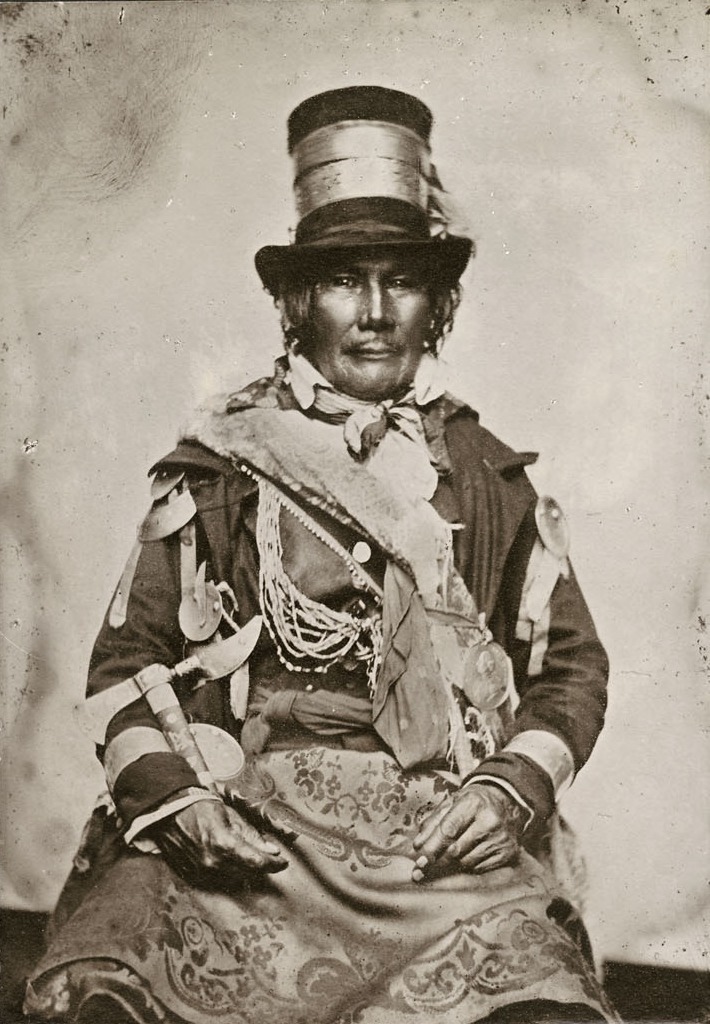
Ogimaa Oshawana of Bkejwanong, 1858. Library and Archives Canada, C-008543 / e010797042. Public domain. A face for the Nations of the Strait chapter that opens this timeline. - Time immemorial to today Bkejwanong. Walpole Island First Nation, Bkejwanong, 'where the waters divide', is home to Ojibwe, Odawa and Potawatomi people of the Council of Three Fires. It is unceded territory. Chapter: Nations of the Strait
- Late 1600s A resting place at the strait. Walpole Island's own history says the Three Fires gave the Huron-Wendat a small tract at the strait to live on until they could return home. An Odawa village stood on the Canadian shore near today's tunnel. Chapter: Nations of the Strait
- 1700s Orchards and pear trees. French orchards and the old 'Jesuit' pear trees, noted by the Windsor Public Library and the Encyclopedia of French Cultural Heritage in North America. Chapter: The French Shore
- 1701 Fort Pontchartrain. Antoine Laumet de Lamothe Cadillac founds the French post at Detroit, on the north shore opposite today's Goyeau and Ouellette. Chapter: The French Shore
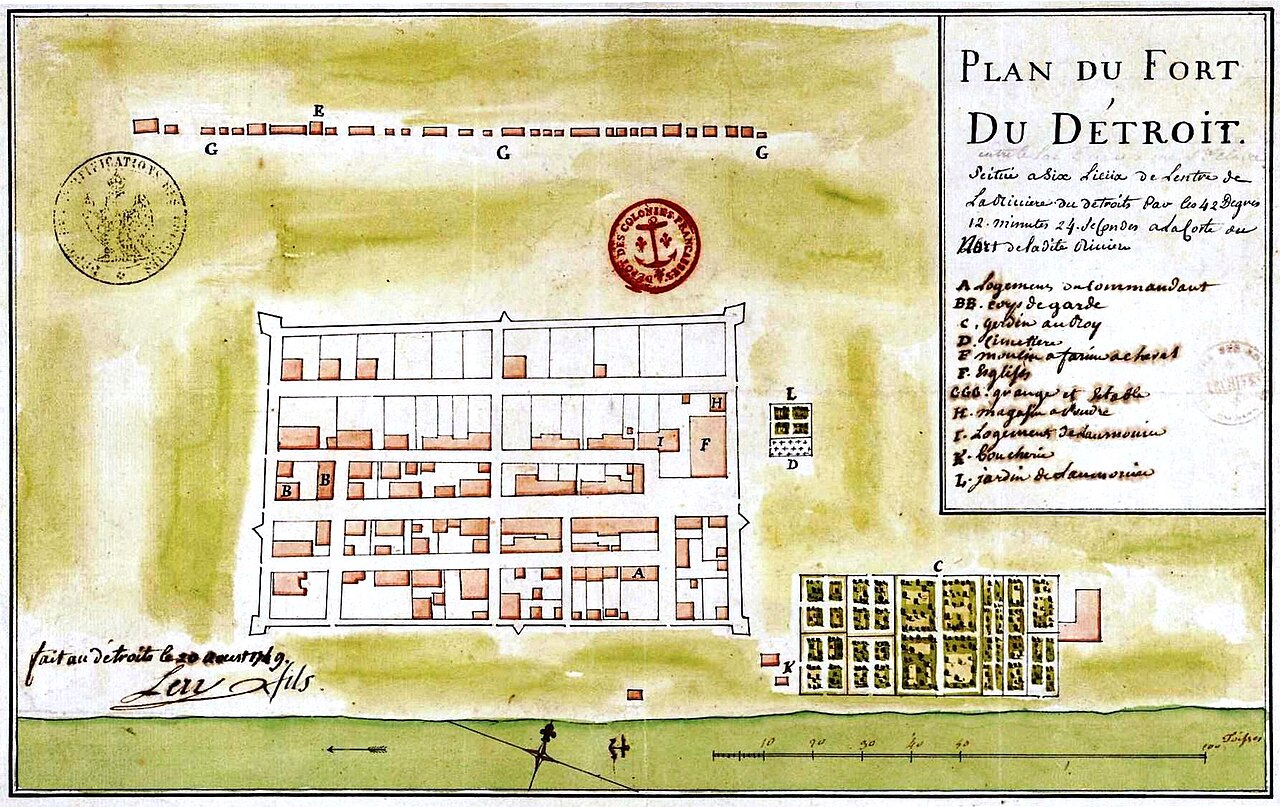
Plan du fort du Détroit, 1749. Gaspard-Joseph Chaussegros de Léry. Library and Archives Canada. Public domain. - 1728 The Huron mission. A Jesuit mission to the Huron at Detroit begins the roots of today's Assumption parish. Windsor Public Library: the mission moved to Bois Blanc Island in 1742, then to la Pointe de Montréal on the south shore. Chapter: Nations of the Strait
- 1748 A village near today's bridge. Some Huron settle near the site of today's Ambassador Bridge and give land beside their village to the Jesuits for a church. Walpole Island's research says the Three Fires did not consent to these land gifts. Chapter: Nations of the Strait
- 1749 La Petite Côte. Twenty-two families receive south-shore grants after the 1749 proclamation: the first permanent European farm settlement in what is now Ontario (Archives of Ontario). Chapter: The French Shore
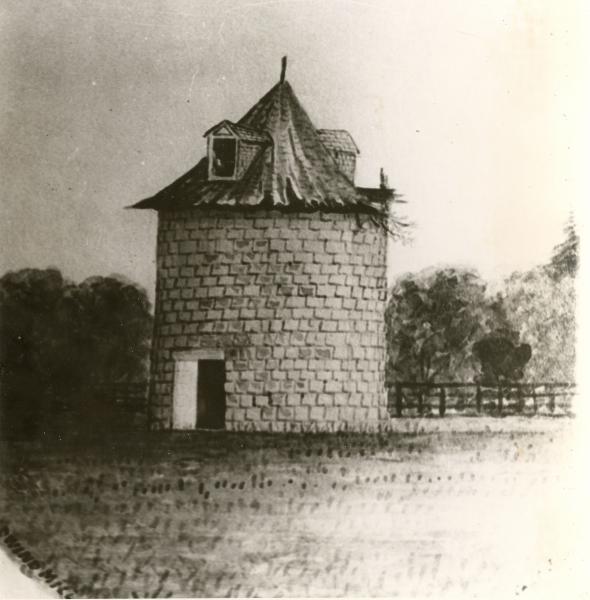
Windmill, Petite Côte (built 1803). From a watercolour by Capt. James Van Cleve, 1881, in F. Neal, The Township of Sandwich (1909). SWODA. Public domain. - 1749 to the 1800s Ribbon farms. Long, narrow lots fronting the river still shape blocks and street names: Ouellette, Drouillard, Marentette, Goyeau, Lauzon. Chapter: The French Shore
- 1760 to 1763 The British take over. Both shores pass to British control from 1760; the Treaty of Paris follows in 1763. Chapter: The French Shore
- 1767 Assumption Parish. The Huron mission becomes Assumption Parish, the first parish in what is now Ontario. Chapter: The French Shore
- 1789 and earlier Slavery on the frontier. The City of Windsor's museum records that Jacques Duperon Baby enslaved about 20 Black and Indigenous people. Slavery was part of life on both shores in this period. Chapter: The French Shore
- 19 May 1790 McKee's Purchase. Anishinaabe and Wyandot leaders surrender land from Lake Erie to the Thames to the Crown for £1,200 currency of the Province of Quebec in goods delivered by Alexander McKee (blankets, cloth, kettles, guns, powder, rum, a bullock and more, scheduled in the deed). Two reserves are set apart in the deed itself: one from a run near Bois Blanc Island up the strait to the French settlement above Petite Isle au D'Inde, then east seven miles and south to close (the Anderdon reserve); and another from the mouth of Rivière au Jarvais (Knagg's Creek) up the strait to the Huron Church, 120 arpents deep. Caldwell First Nation did not sign. Frans. Baby, Ensign of Militia, witnessed the deed. It was recorded at L'Assomption, District of Hesse, on 22 June 1790 (Register B, pp. 374 to 378). Chapter: Nations of the Strait
- 1790 The Anderdon Reserve. About 200 Wyandot settle the Anderdon Reserve near Amherstburg, 23,330 acres (Wyandot of Anderdon Nation history). Chapter: Nations of the Strait
- 1791 A rectangle becomes a triangle. Surveyor Patrick McNiff runs the Huron Church Reserve's side lines along settlers' lots. Walpole Island's analysis: the reserve shrank from about 4,560 acres, the 1790 rectangle, to about 1,139 acres. Chapter: Nations of the Strait
- 1796 to 1797 A river becomes a border. Detroit is handed to the United States in 1796. The Sandwich townsite is laid out in 1797 as the British seat on this side. Chapter: Sandwich and the New Border
- 1796 Fort Malden. The British build their new post downriver at Amherstburg after giving up Detroit. Chapter: Sandwich and the New Border
- 2 June 1797 'The proper owners of the soil'. Alexander McKee goes to Walpole Island to buy the Huron Church Reserve from the chiefs there. A provisional deal keeps 61 acres beside the church as a camping ground for Walpole Island people. Chapter: Nations of the Strait
- 1798 The Duff-Baby House. Built for Alexander Duff at 221 Mill Street, it later served as a headquarters in the War of 1812. It is an Ontario Heritage Trust property today. Chapter: Sandwich and the New Border
- 11 September 1800 Deed No. 12. The 1,078-acre Huron Church Reserve is sold to the Crown for £300 in goods: blankets, kettles, cloth, tools, ammunition and a bullock. The same deed takes 1,334 acres by the Amherstburg garrison and a 41-acre road as a 'gift', 1,375 acres that the deed rounds to '1,380 or thereabouts'. In all, 2,412 acres and a road. Odawa, Ojibwe, Potawatomi and Wyandot chiefs signed, among them Roundhead (Ustaiechta); Thomas McKee accepted for the Crown; commissioners F. Baby and Alexander Duff witnessed. Chapter: Nations of the Strait
- 1800s Across the river to freedom. The University of Windsor's digital exhibit gathers early Black history in Sandwich. Chapter: Freedom Shore
- 17 November 1807 Treaty of Detroit. The Ottawa, Chippewa, Wyandot and Potawatomi sign a treaty with the United States at Detroit, on the American side of the river, with William Hull for the United States. The manuscript survives in the Library of Congress. The printed Kappler edition matches the date and parties. Chapter: Nations of the Strait
- 1812 to 1813 Oshawana beside Tecumseh. Oshawana (John Naudee), later a chief at Walpole Island, was Tecumseh's chief warrior at the Battle of the Thames, 5 October 1813 (Canadian War Museum; Library and Archives Canada). Chapter: Nations of the Strait
- 12 July 1812 Hull invades. U.S. General William Hull crosses the river and occupies the unfinished Baby house at Sandwich. Chapter: War on the River
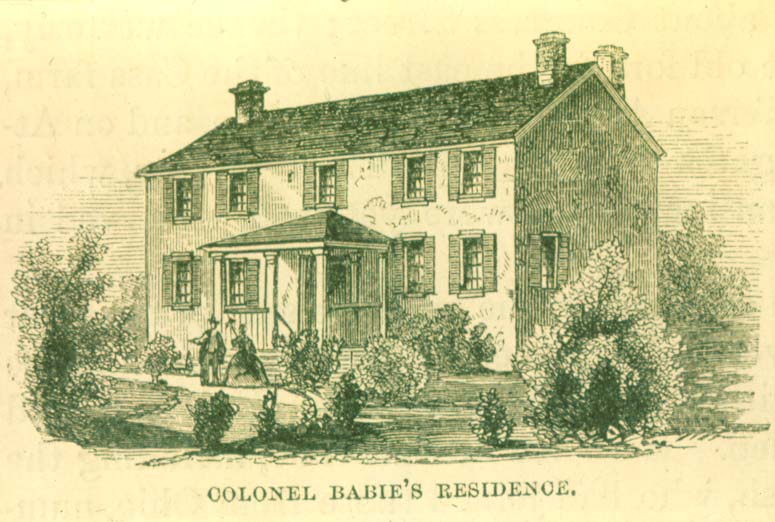
François Baby house as in 1812. Sketch by Benson J. Lossing, Pictorial Field-Book of the War of 1812 (1868). Public domain. - 16 August 1812 Detroit taken. British forces under Isaac Brock and Indigenous allies under Tecumseh capture Detroit. Chapter: War on the River
- 1820s to 1930s The ferries. A horse ferry runs from 1827, and the Detroit and Windsor Ferry Company follows (Ontario Historical Society ferry history). Chapter: Rails, Ferries and Crossings
- 1836 Anderdon cut down. At Amherstburg on 20 September 1836, Wyandot chiefs and warriors propose in ITS Surrender No. 46 to give up the south third of the Huron Reserve for the general expenses of the Indians in Upper Canada, to have the Crown sell the north third for the tribe's interest, and to keep the stone quarry (and by implication the middle third). Lt. Gov. F. B. Head approved; warriors absent from council assented on 26 September 1836. The Wyandot of Anderdon Nation's history says the reserve was cut to 7,770 acres and the stone quarry; that acre figure is not in the ITS No. 46 text we have. Chapter: Nations of the Strait
- 1836 Named Windsor. The hamlet around the ferry dock, known as the Ferry, Richmond or South Detroit, agrees on the name Windsor. Chapter: Rails, Ferries and Crossings
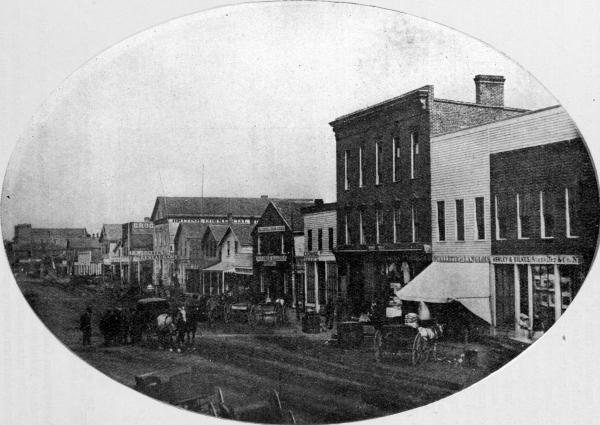
Sandwich Street, Windsor, 1863. Southwestern Ontario Digital Archive (node 388). Public domain. An earlier streetscape of the riverfront city that later became the Border Cities and the strike capital of 1945. - 1837 and 1841 Return to Bkejwanong. Potawatomi and Odawa families return from Michigan and settle on Walpole Island. These are the dates the Nations give themselves, in their 1869 Memorial. Chapter: Nations of the Strait
- 4 December 1838 The Battle of Windsor. A Patriot raid from Michigan is routed in the Baby orchard, the last of the 1838 raids. Chapter: War on the River
- 1851 to 1946 Residential schools. Walpole Island children are sent to Mount Elgin, Shingwauk, the Mohawk Institute and other schools. Mount Elgin, at Muncey, operated from 1851 to 1946. Walpole Island's memorial monument carries about 400 survivors' names. Chapter: Nations of the Strait
- 1 January 1851 Voice of the Fugitive. Henry and Mary Bibb publish their abolitionist newspaper at Sandwich. The Refugee Home Society follows in 1851. Chapter: Freedom Shore
- 1851 Sandwich First Baptist Church. Built by Underground Railroad settlers at 3652 Peter Street; a National Historic Site. Chapter: Freedom Shore
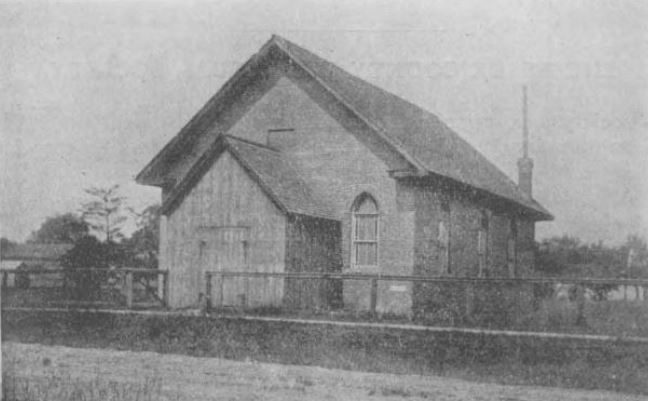
Sandwich First Baptist Church (early photo). From Frederick Neal, The Township of Sandwich Past and Present (1909), p. 195. Public domain. - 19 July 1853 The camping ground surrendered. Indian Agent J. B. Clench certifies Surrender No. 71, by which eight named Wyandot chiefs and principal men at Anderdon (Joseph White, Matthew Greyeyes, William Clarke, Alexander Clarke, James Clarke, Joseph Warrow, Francis Parke and Alexis Matthias Splitlog) surrender a triangular tract commencing on Detroit Street, running along the Detroit River to the Huron Church line, then along a rivulet to a bridge on the Queen's Highway and back along Detroit Street (the 61-acre camping ground). Dated Anderdon, 19 July 1853. Walpole Island says the Three Fires were not party to it and calls the surrender improper. Chapter: Nations of the Strait
- 24 March 1853 The Provincial Freeman. Mary Ann Shadd issues a first, trial number in Windsor; regular publication followed in Toronto. Chapter: Freedom Shore
- 1854 The railway arrives. The Great Western Railway reaches its terminus here. Windsor becomes a village in 1854, a town in 1858 and a city on 14 April 1892. Chapter: Rails, Ferries and Crossings
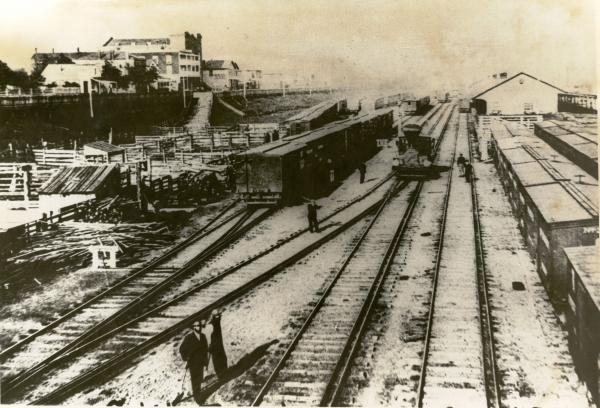
Great Western Railway yards, Windsor. Southwestern Ontario Digital Archive (node 1045). Public domain. The Great Western reached its terminus here in 1854. - 1855 to 1856 The Essex County Court House. Today's Mackenzie Hall was the courthouse until 1963 and has been a cultural centre since 1985. Chapter: Sandwich and the New Border
- 1857 Assumption College. Assumption College opens in Sandwich. It became Assumption University in 1956, and the University of Windsor was incorporated in 1962. Chapter: Sandwich and the New Border
- 1858 Walkerville. Hiram Walker founds a company town east of Windsor. Its industry is covered in Works and Wages. Chapter: Border Cities
- 1858 to the 1930s A company town you can still walk. The Ontario Heritage Trust and Tourism Windsor Essex Pelee Island describe Walkerville's surviving company-town architecture. Chapter: Border Cities
- 1860s Ships at Walkerville. The Jenking yard at Walkerville builds Detroit River ferries in the 1860s and 1870s. (What Canadian Bridge built in the Second World War is described differently by different sources, so we leave it to the War Chest.) Chapter: Works and Wages
- 1 January 1867 Trains on the water. The Great Western's car ferry Great Western, assembled at Walkerville, begins carrying rail cars across the river. Chapter: Rails, Ferries and Crossings
- 1868 to 1961 BME Church, McDougall Street. The British Methodist Episcopal Church at 363 McDougall Street was built in 1868 and demolished in 1961, part of the McDougall Street Corridor's Black heritage. Chapter: Freedom Shore
- 1869 The Walpole Island Memorial. Printed at Sarnia and addressed to Governor General Sir John Young, it claims the Huron Reserve and Fighting, Bois Blanc, Turkey and Pelee islands. It says Bois Blanc was reserved as 'a place of landing, camping and holding Councils' and never surrendered, and that Pelee Island was only leased to Thomas McKee. Chapter: Nations of the Strait
- 1882 The Grand Trunk. The Great Western is absorbed by the Grand Trunk; the ferry passes to the new owner. Chapter: Rails, Ferries and Crossings
- 1882 to 1888 Hiram Walker's railway. The Lake Erie and Detroit River Railway runs from Walkerville toward Kingsville and Leamington (Walkerville history; one source). Chapter: Rails, Ferries and Crossings
- 6 June 1886 An electric streetcar. The Windsor Electric Railway, two miles from Windsor to Walkerville on Charles Van Depoele's system, is reported as Canada's first electric streetcar line. Chapter: Rails, Ferries and Crossings
- 1891 and 1893 Salt. A Canadian Pacific test well finds salt in 1891. The Windsor Salt Company starts in 1893 and the Canadian Salt Company in 1901. Chapter: Works and Wages
- 14 April 1892 A city. Windsor is incorporated as a city. Chapter: Border Cities
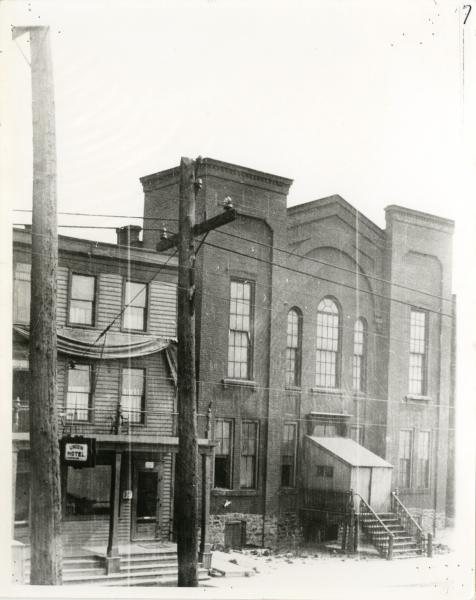
Old Town Hall, Windsor. Southwestern Ontario Digital Archive (node 402). Public domain. Windsor became a city on 14 April 1892. - 1892 Windsor Wheelmen. The region's first cycling club rides in the 1890s bicycle craze, including cross-border rides to Detroit (Windsor Law cycling history report). Chapter: City and Society
- 1898 to 1993 Bob-Lo Island. The island amusement park reached by steamer. See our Lost Windsor story. Chapter: City and Society
- 1904 to 1906 Willistead Manor. Albert Kahn designs the house for E. C. Walker. It was given to Walkerville in 1921 and came to the City of Windsor after 1935. Chapter: Border Cities
- 17 August 1904 Ford of Canada. Gordon McGregor founds the Ford Motor Company of Canada in the former Walkerville Wagon Works. Chapter: Works and Wages
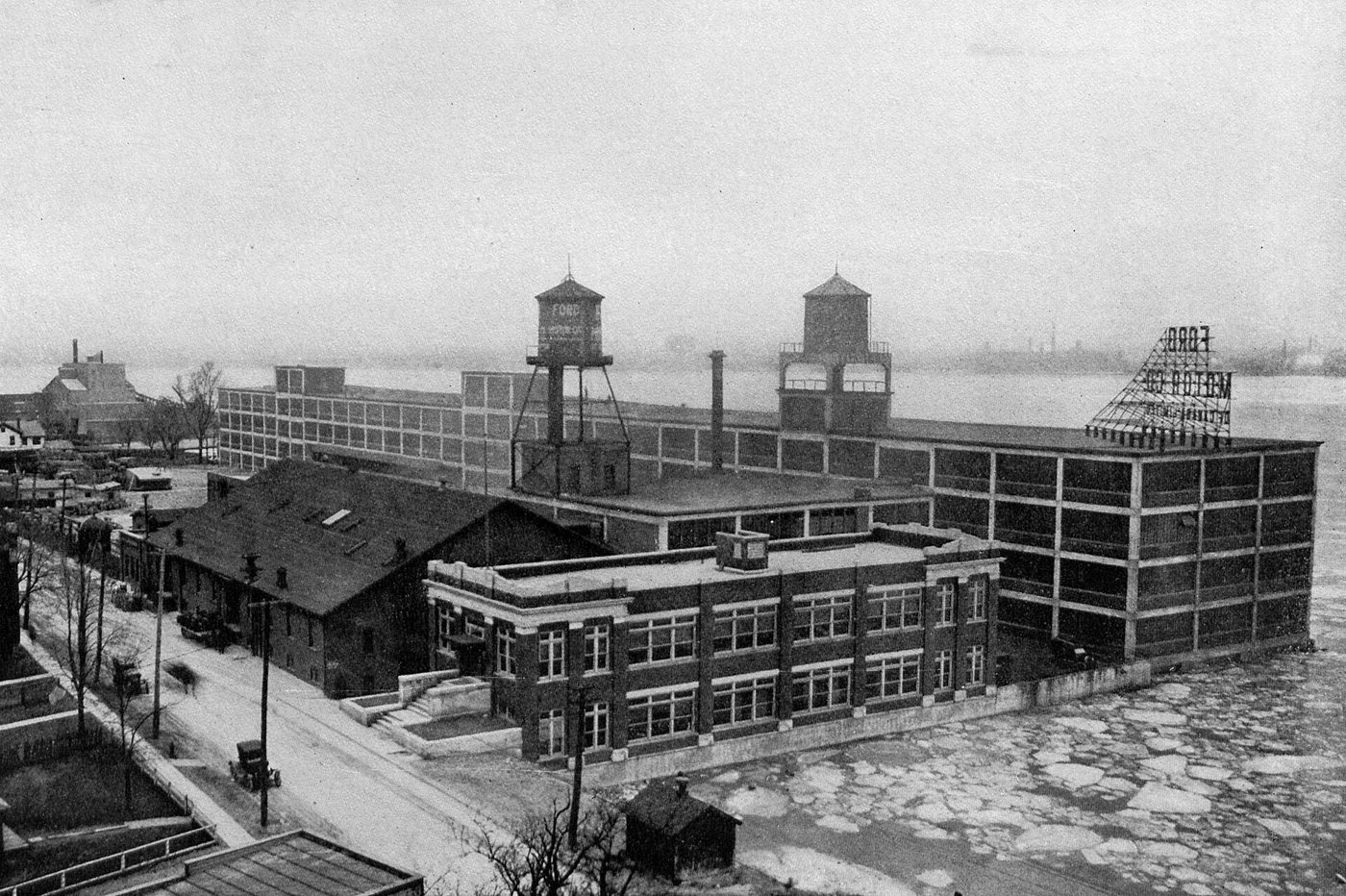
Ford Motor Co. of Canada plant, 1913. Gardner, Windsor, Ontario, Canada, 1913, p. 84. Public domain. Via Canadiana.ca / Wikimedia Commons. - 1904 117 Model Cs. The first large-scale car production in Canada: 117 Model C Fords at the wagon works (Canadian Vehicle Manufacturers' Association). Chapter: Works and Wages
- 1904 to 1971 Read the records. The Ford Motor Company of Canada records at the University of Windsor's Leddy Library are open to researchers. Chapter: Works and Wages
- 1909 Jack Johnson at Lagoon Park. The City of Windsor's Emancipation monument panels say boxer Jack Johnson appeared at the 1909 Emancipation celebration in Lagoon Park, Sandwich, before about 10,000 people. Chapter: Freedom Shore
- 26 July 1910 The rail tunnel. The Michigan Central Railway Tunnel opens, an early immersed-tube tunnel under the Detroit River. Chapter: Rails, Ferries and Crossings
- 1910s to 1920s More automakers. Studebaker, Hupp and Maxwell build plants in the Border Cities (Windsor Public Library, 'Windsor on Wheels'). Chapter: Works and Wages
- 1913 The 1913 picture book. Harry Wentworth Gardner's 'Windsor, Ontario, Canada, 1913' records about 90 public-domain views of Windsor, Walkerville, Ford, Sandwich and Ojibway. Many pictures on this site come from it. Chapter: Border Cities
- 1916 to 1933 Two prohibitions. Ontario's Temperance Act of 1916 banned sales in the province until 1927, but export stayed legal. U.S. Prohibition ran from 1920 to 1933. The river between them became a smuggling route. Chapter: Rum Row
- 1916 to 1935 Kenilworth Park. The racetrack where Man o' War ran his last race, 12 October 1920. See our Lost Windsor story. Chapter: City and Society
- About 1920 The bridge that was never built. A Detroit Publishing postcard shows Charles Evan Fowler's proposed Detroit-Windsor bridge with an '1803 ft. span'. It was never built. Chapter: Rails, Ferries and Crossings
- 1920s Customs and enforcement. Smuggling did not stop in winter; our October 2026 story follows the crossings over the ice. Chapter: Rum Row
- 1922 Point Pelee. Parks Canada and APTN record that Caldwell people were expelled from Point Pelee National Park, on the mainland, after it was created. Caldwell First Nation's own account, as reported by CBC, is that families were burned out of their homes 'by the RCMP' in the 1920s. Point Pelee is not Pelee Island. Chapter: Nations of the Strait
- March 1922 The Sandwich ruling. Judge Coughlin at Sandwich rules that the province cannot regulate export warehouses (Detroit Free Press, 26 March 1922). Chapter: Rum Row
- 1925 Chrysler Canada. Chrysler Corporation of Canada is incorporated in June 1925 from Maxwell-Chalmers, with a plant on Tecumseh Road. Chapter: Works and Wages
- 1929 The bridge and the camping ground. Walpole Island Heritage Centre research (2013) places the Canadian end of the Ambassador Bridge inside the 61-acre camping ground, with river footings in water-bed land never surrendered. This is the Nation's research, credited to it. Chapter: Nations of the Strait
- 11 and 15 November 1929 The Ambassador Bridge. Dedicated 11 November 1929; opened to traffic 15 November 1929. Walpole Island's research places its Canadian landing in the 1797 camping ground (see Nations of the Strait). Chapter: Rails, Ferries and Crossings
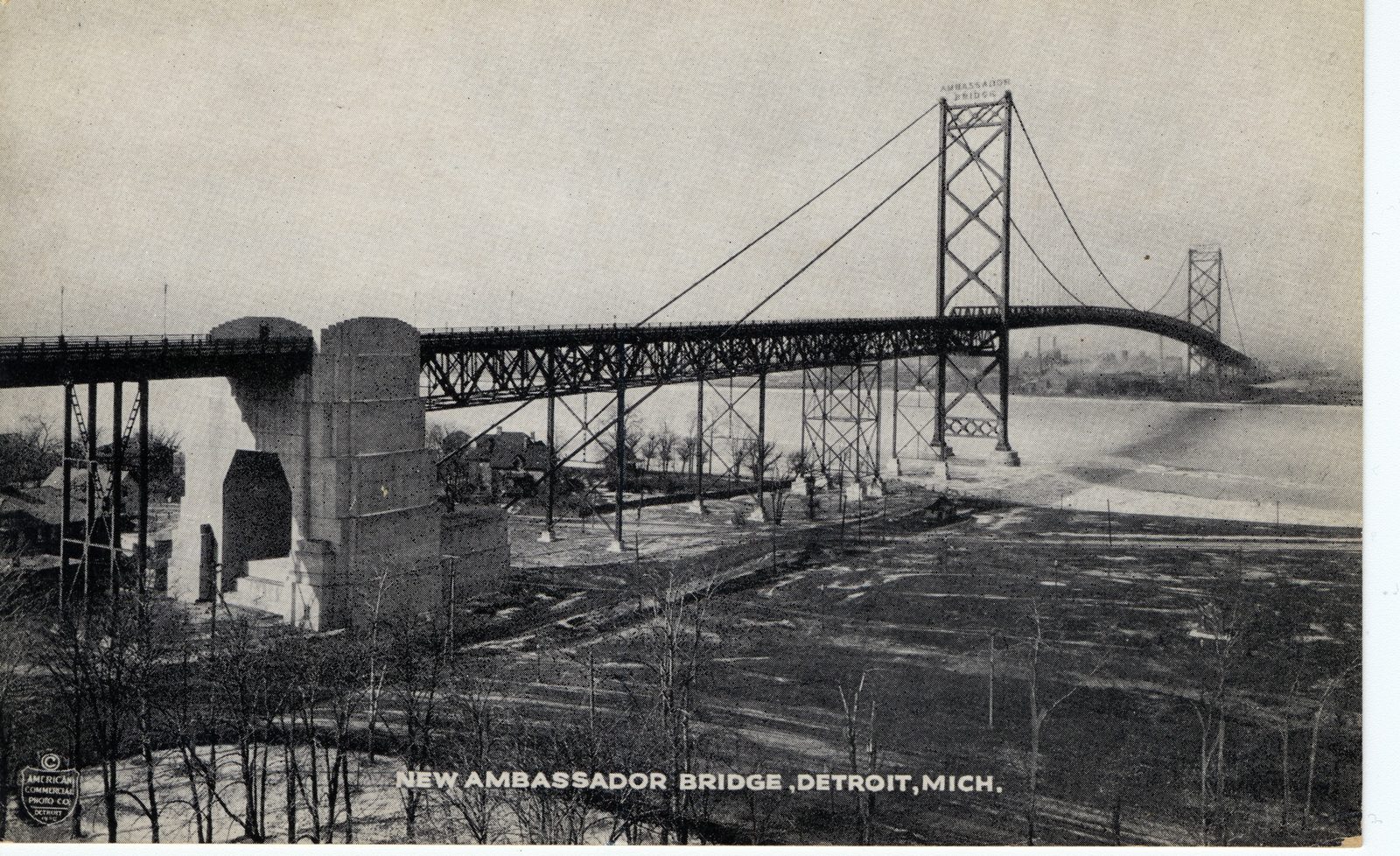
Ambassador Bridge from the Canadian side, about 1930. Postcard, American Commercial Photo Co. SWODA / Internet Archive (2545_SWODA). Public Domain Mark 1.0. - 1929 Jackson Park. Council names the former Windsor Jockey Club grounds for Mayor Cecil E. Jackson. Read the full story: Chapter: City and Society
- 1 to 3 November 1930 The Detroit-Windsor Tunnel. Dedicated on 1 November, open to the public on 3 November 1930. Chapter: Rails, Ferries and Crossings
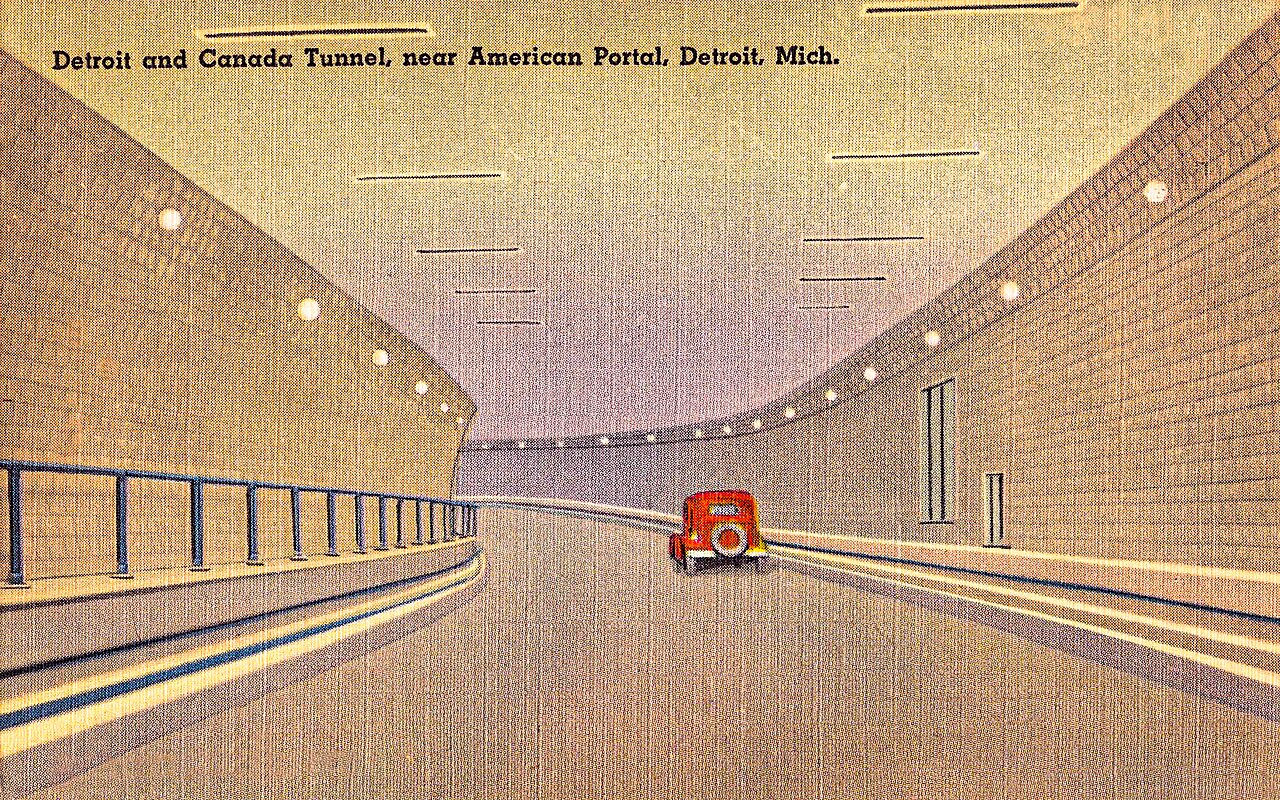
'Off to Canada' tunnel postcard, about 1935. Scan by Jim Griffin, CC0, via Wikimedia Commons. - 1931 to 1935 The Border Cities default. East Windsor defaults in 1931, Sandwich and Windsor in 1932 and Walkerville in 1934. A provincial finance commission takes control, and the crisis leads to the 1935 amalgamation (Kulisek and Price, 1988). Chapter: Booms and Busts
- 1932 to 1966 The Greatest Freedom Show on Earth. Walter Perry began organizing Windsor's Emancipation celebrations about 1932. The large Jackson Park festivities ran every year from 1935 to 1966. The 1967 celebration was cancelled after the Detroit uprising, and Perry died on 17 August 1967. Read the full story: Chapter: Freedom Shore
- 1935 Amalgamation. Windsor, East Windsor (renamed from Ford City in 1929), Walkerville and Sandwich amalgamate. Chapter: Border Cities
- 1938 and 1942 The last ferries. The Windsor to Detroit ferry ended in 1938. The last Walkerville to Detroit run was logged on 15 May 1942. Chapter: Rails, Ferries and Crossings
- 7 May 1939 Last streetcars. Buses replace Windsor's streetcars. Streetcar 351 is restored downtown today. Chapter: Rails, Ferries and Crossings
- 1939 to 1945 The arsenal. Wartime production, including Ford's Universal Carriers. Windsor War Chest tells this story. Chapter: Works and Wages
- September to December 1945 The Ford strike. A 99-day strike at Ford. Justice Ivan Rand's decision of 29 January 1946, the Rand Formula, shaped Canadian labour law. Chapter: Works and Wages
- 17 June 1946 The Windsor-Tecumseh tornado. An F4 tornado kills 17 people. We remember them here, and it is not a Lost Windsor story. Chapter: Booms and Busts
- 1948 Ford of Canada from the air. A Ford Motor Company film shows Windsor, the bridge and Plants 1 and 2. It is public domain in the Ford Film Collection at the U.S. National Archives. Chapter: Works and Wages
- 1955 The Ojibway mine. The Canadian Salt Company begins production at its Ojibway mine, at the 965-foot level (GeologyOntario). Chapter: Works and Wages
- 7 May 1958 A museum in the Baby House. The François Baby House opens as the Hiram Walker Historical Museum, today Museum Windsor. Chapter: Sandwich and the New Border
- Early 1960s The City of Roses. The Greater Windsor Foundation's rose campaign gives Windsor its nickname, and this section its name. Chapter: City and Society
- 1960s Annexations. Riverside, Ojibway and parts of the Sandwich townships join the city. Chapter: City and Society
- Late 1960s The riverfront trail. The trail now called the Roy A. Battagello River Walk begins, about 8 km from the Ambassador Bridge to the old distillery site. Chapter: City and Society
- 16 January 1965 The Auto Pact. The Canada-U.S. Automotive Products Agreement. Hansard records 20 new Windsor-area parts plants and about 5,000 jobs between 1964 and 1971. Chapter: Booms and Busts
- 1971 to 1991 The Ganatchio Trail. Rotary-built and named for the Indigenous name of Lake St. Clair; phase one opened in 1983 and the Little River extension in 1991. Chapter: City and Society
- 2 November 1983 The minivan. After a refit of about $400 million, Windsor Assembly starts building the Dodge Caravan and Plymouth Voyager. Chapter: Works and Wages
- 2010 to 2011 Caldwell's claim settled. Caldwell members approve a $105 million settlement on 21 August 2010; Canada approves it on 2 March 2011 and announces it on 25 March 2011. The claim is tied to the 1790 treaty and Point Pelee land promised in the War of 1812. Chapter: Nations of the Strait
- 2016 Herb Gray Parkway trails. About 17 km of walking and cycling paths open with the parkway. Chapter: City and Society
- November 2020 A band without land no more. After a 230-year fight, Caldwell First Nation's land near Leamington gains reserve status (CBC, 24 November 2020). Chapter: Nations of the Strait
- 2022 Caldwell and Point Pelee. Joint conservation, ceremony and interpretation at Point Pelee National Park, described by Caldwell as true to the Anishinaabek way of life (CBC). Chapter: Nations of the Strait
- 2024 The Enniskillen claim. Canada's offer to Walpole Island, about $46 million with an option to add up to 400 acres of reserve, goes to a community vote that is put off in August 2024. Researchers said the Nation may be owed more. Chapter: Nations of the Strait
- March 2025 Water. A 'do not consume' advisory at Walpole Island after an upstream spill. Bkejwanong draws its water from the St. Clair River downstream of Sarnia's chemical plants. Chapter: Nations of the Strait
- 1 August 2026 A monument in Jackson Park. The City's Emancipation Celebration Monument opened on Emancipation Day 2026, with an arch shaped like the old bandstand and murals by Dennis K. Smith. Chapter: Freedom Shore
- 24 July to 5 August 2026 The Gordie Howe International Bridge. Opening ceremony on 24 July, vehicles from 27 July, and a toll-free walking and cycling path from 5 August 2026. Chapter: Rails, Ferries and Crossings
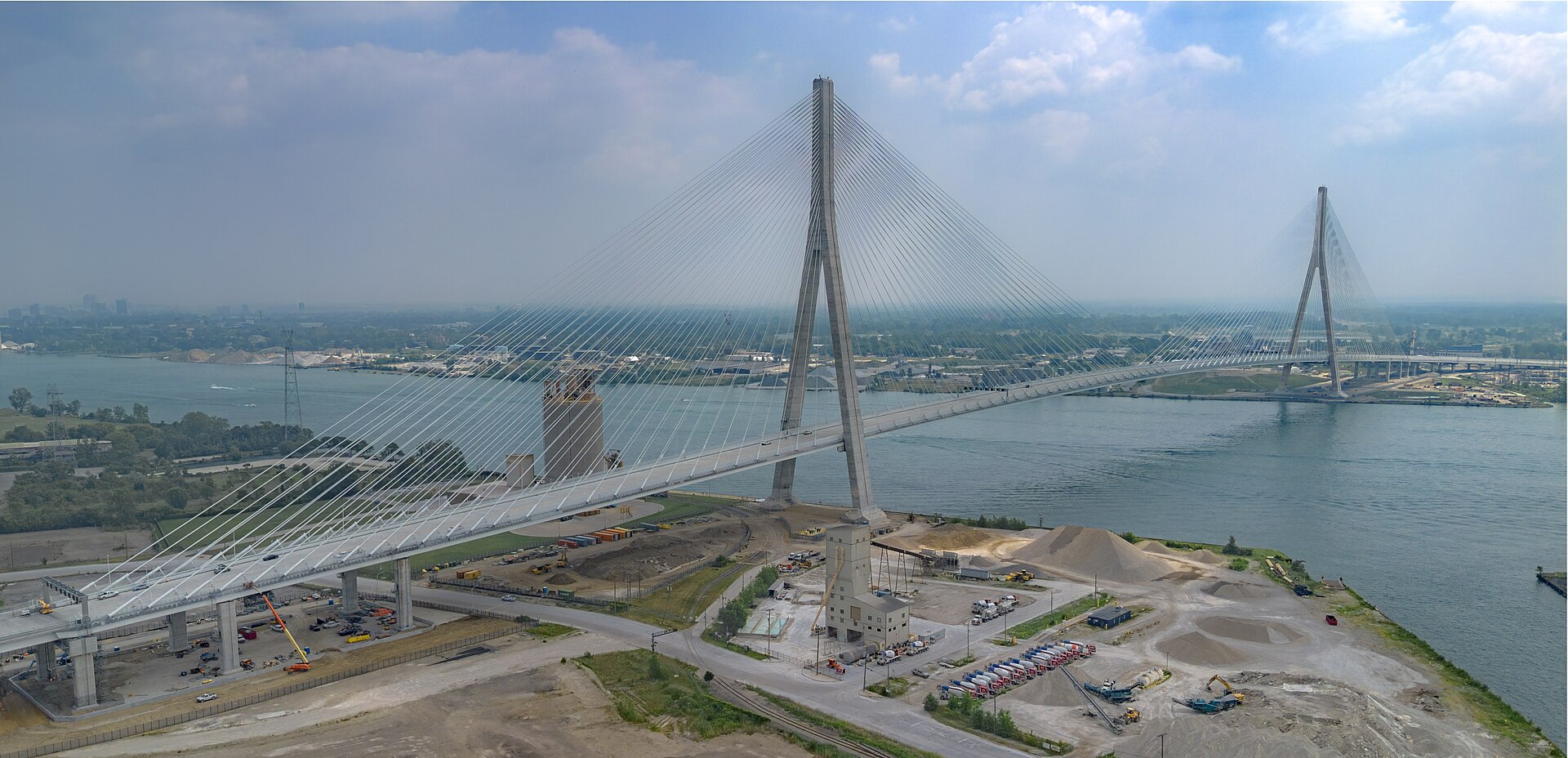
Gordie Howe International Bridge, July 2026. Photo: WMrapids, CC0, via Wikimedia Commons. - 1748 to today Names on the map. Huron Line (Huron Church Road), Wyandotte Street and Indian Road recall the Huron mission at la Pointe de Montréal (Lajeunesse's parish history, reproduced by Assumption Parish). Chapter: Nations of the Strait
- Every 5 May Red Dress Day. Gatherings at the Can-Am Indian Friendship Centre for missing and murdered Indigenous women, girls and two-spirit people. Chapter: Nations of the Strait
- Today In the Nation's own words. Walpole Island Chief and Council publish community updates on claims and news. Chapter: Nations of the Strait
- 1797 to today Walk Old Sandwich Towne. The City of Windsor's Sandwich heritage walking tour (2018) covers the town's surviving buildings. Chapter: Sandwich and the New Border


