526 overdose ER visits in nine months: what Windsor-Essex's 2026 numbers show
Opioid overdose emergency visits in Windsor-Essex from January to September 2026 already top the total for all of 2025. What the health unit's numbers show, the six overdose alerts this year, and where to get help.
Topics: Health
Get these every Sunday: the free Windsor News weekly digest.
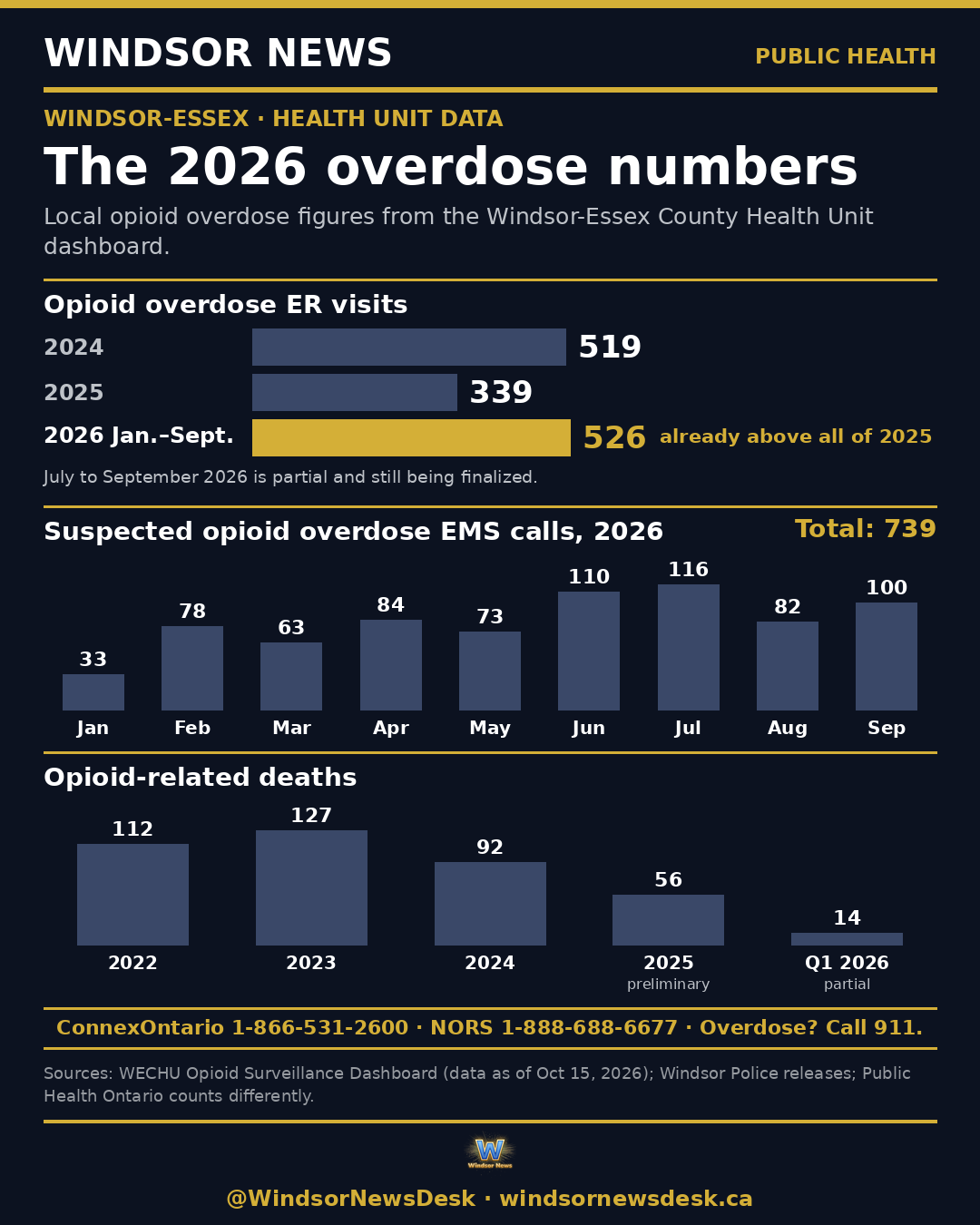
Local hospitals reported 526 opioid overdose emergency department visits in Windsor-Essex from January to September 2026, already more than the 339 recorded in all of 2025 and the 519 in 2024, according to the Windsor-Essex County Health Unit's Opioid Surveillance Dashboard (data as of Oct. 15, 2026). Here is what the local numbers show, how the main sources count, and where to get help.
What the health unit's dashboard shows
The dashboard counts these visits by quarter, and the July to September figure is still being finalized. For comparison, the same dashboard shows 339 visits in all of 2025 and 519 in 2024.
The dashboard also shows 739 suspected opioid overdose calls to Essex-Windsor EMS from January to September 2026.
Deaths are tracked separately and take months to confirm. The dashboard lists 112 opioid-related deaths in 2022, 127 in 2023, 92 in 2024 and 56 in 2025, with the 2025 figure marked preliminary. It shows 14 deaths from January to March 2026, the most recent quarter available. In 2025, Windsor-Essex had the highest rate of opioid-related deaths among Ontario's 10 largest cities, the health unit has said.
Six alerts in 2026
The health unit runs the Opioid and Substance Use Notification System for the Windsor-Essex Community Opioid and Substance Strategy (WECOSS). An alert goes out when the system flags an elevated number of overdoses in a week. These weekly counts are opioid overdoses seen in local emergency department visits:
Feb. 1 to 7: 11 overdoses, 8 involving fentanyl
Feb. 22 to 28: 19 overdoses, 16 involving fentanyl
June 21 to 27: 18 overdoses, 17 involving fentanyl, plus six suspected drug-related deaths. The drugs involved in those deaths were not known when the alert was issued.
June 28 to July 4: 29 overdoses, 19 involving fentanyl
Sept. 27 to Oct. 3: 30 overdoses, 17 involving fentanyl
Oct. 4 to 10: 31 overdoses, 17 involving fentanyl
WECOSS issued two alerts in 2025, in August and December.
How the sources count
The health unit's figures are overdoses reported directly by local hospitals, and its death counts are confirmed deaths. Public Health Ontario's Substance Use and Harms Tool uses provincial records of emergency visits for opioid-related poisonings and includes probable deaths, so its numbers are different. Both sources show 2026 running well above 2025.
EMS calls and emergency department visits are separate measures and are counted separately.
For the year so far, the health unit's dashboard shows 526 opioid overdose emergency department visits through September.
What is driving it
Health officials have pointed to what is in the local drug supply. In July, Eric Nadalin of the health unit said the reactions people were experiencing were consistent with medetomidine, a veterinary sedative, mixed with fentanyl, and that it had shown up in drug seizure data gathered with police. He also said hot weather raises the risk of overdose for people who use substances.
The local response
WECOSS partners include the health unit, Windsor Regional Hospital, Essex-Windsor EMS, Erie Shores HealthCare, the Office of the Chief Coroner and police services. They say they are monitoring the increase and working to understand more about the cases, and ask anyone who knows of links between cases to contact the health unit at 519-258-2146.
Windsor-Essex's Homelessness and Addiction Recovery Treatment (HART) Hub opened Sept. 29, 2025, with its main location at Hôtel-Dieu Grace Healthcare, 1453 Prince Rd. It offers primary care, mental health services, beds and food.
Windsor News has asked the health unit, Windsor Police, Essex-Windsor EMS, the City, Ontario's health ministry and associate addictions minister, Health Canada, the three local MPPs and Ward 3 Coun. Renaldo Agostino what action they plan to take, and whether they will join a joint Windsor-Essex overdose task force. We will report their answers. You can follow the questions and replies on our questions page at windsornewsdesk.ca/foi.
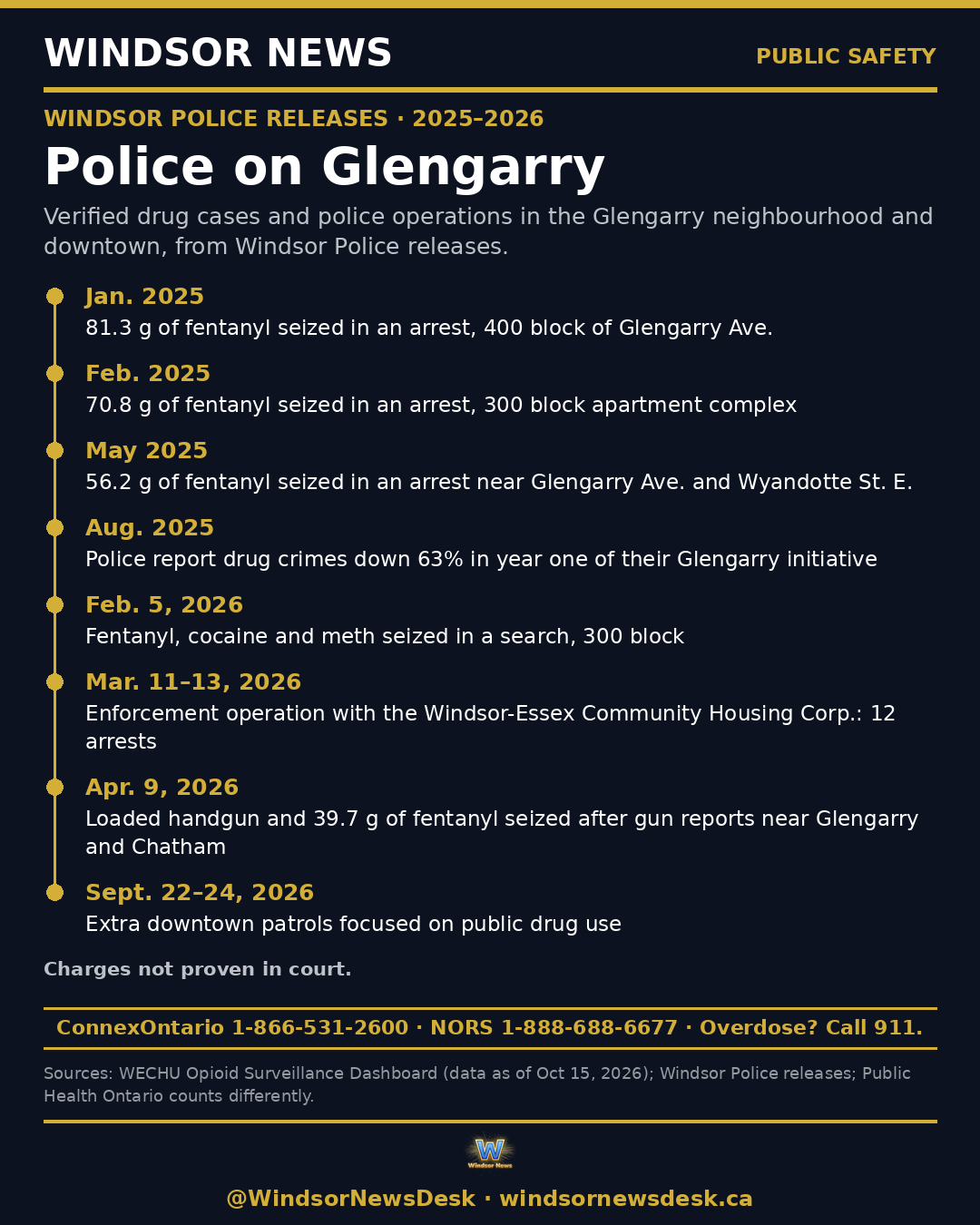
Some readers have raised concerns about drug activity around Glengarry Avenue and Ouellette Avenue downtown. Public police records show drug cases in the Glengarry neighbourhood in both years. Windsor police reported fentanyl seizures in arrests in the 300 and 400 blocks of Glengarry Avenue in January, February and May 2025. On Feb. 5, 2026, officers seized 39 grams of fentanyl, 53 grams of cocaine and one gram of methamphetamine in a search in the 300 block, according to police and the Windsor Star. From March 11 to 13, police and the Windsor-Essex Community Housing Corporation ran an enforcement operation at apartment buildings in the 300 and 400 blocks that led to 12 arrests. Police said more than half of the charges were for breaching release orders or probation. On April 9, police seized a loaded handgun and 39.7 grams of fentanyl after reports of a man with a gun near Glengarry Avenue and Chatham Street. Police reported in August 2025 that drug crimes in the Glengarry neighbourhood fell 63 per cent in the first year of their safety initiative there. Downtown, police ran extra patrols from Sept. 22 to 24, 2026, focused on public drug use. None of the charges has been proven in court. Local overdose alerts cover all of Windsor-Essex and do not name locations, so public data cannot show overdoses for this area. Windsor News has asked Windsor Police how drug and overdose calls in the area compare with 2025 and what it is doing there. We will report its answer.
Where to get help
Overdose: call 911. Stay with the person. The Good Samaritan Drug Overdose Act gives some legal protection to people who experience or witness an overdose and call for help.
ConnexOntario: 1-866-531-2600, 24 hours a day, for help finding addiction and mental health services.
National Overdose Response Service: 1-888-688-6677, a confidential 24/7 line for people using substances, so no one has to use alone.
Free naloxone: kits are free at participating pharmacies with no prescription or Ontario health card needed. Find one at ontario.ca/page/get-naloxone-kits-free.
Local kits and drug test strips: WECOSS lists community organizations that give out free naloxone kits, such as Pozitive Pathways at 511 Pelissier St., and places to get free drug test strips, at wecoss.ca/resource/opioid-poisoning-response-prevention.
WECOSS advises people who use substances never to use alone, to check substances with test strips where available, to start with a very small amount, not to use at the exact same time as a friend, and to avoid mixing substances.
Signs of an opioid overdose
Not responding or not waking up, slow or absent breathing, snoring or gurgling sounds, blue lips or fingernails, cold and clammy skin, and very small pupils. Shout and shake the person's shoulders, call 911 if they do not respond, give naloxone, and give rescue breaths or chest compressions. If there is no improvement after two to three minutes, repeat the naloxone and breaths or compressions.